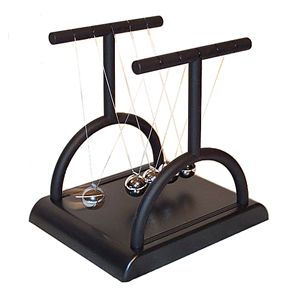
This graphic courtesy of DeskToy.com
THE CHALLENGE:
As shown in the pix above, one of the suspended balls has been pulled away from the rest, and has just been released.
What happens?
The executive challenge is to explain what happens to a five year old -- in a way that satisfies the child as well as you.
According to Piaget, a five year old is at the concrete operational reasoning stage .
Piaget and his co-workers never (to this writer's knowledge) used this executive toy in their studies of children's thinking. But a closely related puzzle was used:
Piaget's Colliding Balls Puzzle
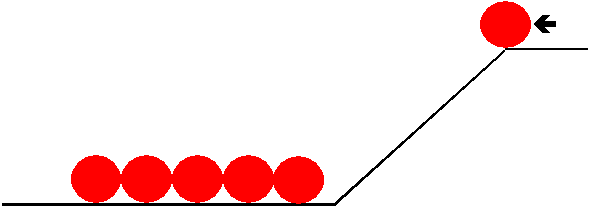
A row of red balls is sitting at the botom of an inclined ramp. At the top of the ramp there is another ball. What happens when the released ball comes down the slope, and collides with the nearest ball?
This problem is best posed using real balls - and not as a theoretical exercise.
Five year old's solutions (after actually witnessing the collision)
When the ball came down the slope the slope, it jumped over the other balls and kept on going.
Eleven year old reports (after actually witnessing the collision)
The ball came down, hit the first, which hit the second, and so on. The ball at the free end just went on ahead.
If the eleven year old is then asked, "How would you explain what happened to another child ?"
typically the child would reply:
The ball coming down the ramp gave its speed to the first ball, which then struck the second, which gave its speed to the seoond, and so on, The second last ball gave its speed to the last, which was then able to go ahead.
According to Piaget, only the child who has reached the formal operation stage of logical thinking can give an answer sensible to an adult.
Piaget and Inhelder (his major collaborator) insisted that transition from one stage to another was not something that could be accelerated.
This Inhelder demonstrated to her satisfaction by showing that children trained to give the correct answer to conservation puzzles, saying "more" as would be appropriate to a "conserver" when tested as to their preferences in manner such as asking "Which of these two chocolate bars do you want?" in fact would exhibit a preference indicating that they were non-conservers.
But in fact one of Inhelders research students, Olivier de Marcellus, circa 1974 developed a learning program -- in which children were asked questions but never "told" or "taught" anything, such that a typical five year old -- subsequent to this program -- gave a credible response to the Colliding Balls Puzzle
What seems most remarkable is that what is here called the kinetic balls executive toy was (allegedly) invented by an eleven year old child, Joe Smitherman, of Ridgecrest Elementary School, in Amarillo, Texas in 1965. Sir Isaac Newton never discussed the collision of billiard balls and the like in his opus, the Principia. The first credible accounts of the collision behavior of billiard balls and the like was given by d'Alembert almost one hundred years later. Does that mean that in accord with Piaget's theory of stages, until d'Alembert all physicists were locked in at the concrete operational stage ?
 : : : : : :on
Olivier de Marcellus and the "Colliding Balls Puzzle"
: : : : : :on
Olivier de Marcellus and the "Colliding Balls Puzzle"
: : : : : : : : : : : : :on the Geneva PhD student who challenged Piaget's canon. |
|
: : : : : :
puzzles where the By Pass Heuristic is SO powerful
: : : : : : : : : : : : : : Strategic Problem Solving by Children, MIT Professors, Horses and Donkeys |
|
: : : : : :The Art of Snaring Dragons
An introduction to the MIT Artificial Intelligence Laboratory
: : : : : : : : : : : : : Memo No 338 with this title. |
|
: : : : : :Dragon Home Page
where you will meet the formidable Water Dragon, various Geckoes,
and learn of Lakatosian Monsters. |